


Providing the right European payment methods in your online shop or for your digital services is key to increase conversion and reduce cart abandonment. But Europe is a diverse ecosystem, so choose wisely.
Acccording to the Global Payments Report 2026 from Worldpay, most European consumers prefer digital wallets (PayPal, Apple Pay, Google Pay) and debit and credit cards over other payment methods.
- Digital wallets (38%)
- Debit and prepaid (17%)
- Credit cards (19%)
- A2A or Pay by Bank (14%)
- Buy-now-pay-later (BNPL) (9%)
- Others (4%)
Note: The Worldpay report has covered a wide range of countries in Europe but not all of them: Belgium, Denmark, Finland, France, Germany, Ireland, Italy, Netherlands, Norway, Poland, Portugal, Spain, Sweden, Switzerland, Turkey, UK
Credit Cards #
Visa and Mastercard are by far the most popular non-domestic credit cards used in European countries. Cards like American Express or Diners Club barely make a mark statistically and therefore will not have much of an impact.
However, the market share of Visa and Mastercard depends heavily on the specific countries.
In a recent report by Statista, France has a very high market share whereas Finnish and Polish customers rarely pay with credit cards. The UK is also known to be a power user when it comes to card payments (Source: Statista, 2025). The Worlpay Global Payments Report 2026 states that Turkey leads when it comes to online credit card payments with 52% of surveyed consumers using them, e.g. every second consumer pays with credit card.
Finland, Poland, the Netherlands, Belgium and Germany have some of the lowest usage.
- Turkey (52%)
- Switzerland (27%)
- UK (23%)
- Norway (22%)
- France (20%)
Mobile/Digital Wallets #
Digital wallets are currently the frontrunners when it comes to preferred online payments, however, depending on your market, it is important to know which (few) countries are hesitant to use them.
Although adoption is generally incredibly high across Europe, with Germany leading (probably due to the popularity of PayPal), Turkey, the Netherlands and Poland are markets where a successful payment mix for eCommerce does not have to include digital wallets. Aside from Germany, the Nordics are also high adopters of digital wallets.
- Germany (52%)
- Denmark (44%)
- Sweden (44%)
- Norway (43%)
- Ireland (42%)
Although Apple Pay and Google Pay can be considered popular payment methods, many European countries are using PayPal. In Germany, it’s probably the reason why digital wallets top the payment preferences for eCommerce. According to Statista, 91% of German users pay with PayPal. In comparison: 17% use Apple Pay or Google PayDebit & bank transfers
Although in-store payments via PayPal are much lower (31 % to 49 %), the online payments market share in Europe ranges from 76 % to 91 %.
(Source: Statista, 2024)
In most European countries, Apple Pay is quite popular for in-store payments (usage ranges from 30 % to 67 %), whereas online, consumers are less likely to use Apple Pay (15 % to 40 %), probably because they have other payment methods in place.
(Source: Statista, 2024)
Debit card payments #
Debit card payments are generally more popular in Europe but have some of the lowest usage rates in selected countries. Only 1% of Germans pay their online purchase with debit cards (they are much more likely to use them offline). Italy, the Netherlands and Poland are equally low users.
English- and French-speaking countries are high adopters, though:
- Ireland (31%)
- France (28%)
- Belgium (26%)
- UK (22%)
- Switzerland (21%)
Domestic payment methods in Europe #
Nearly every European country has at least one local payment method that is very popular and might also help your business to signal trust and market awareness. However, this is not to say that you should offer every single payment method available if you want to expand across Europe. Focus on markets that have enough potential revenue gain that a focus on a local payment method is worth it.
For example, in Denmark, offering MobilePay can increase conversions significantly since it is one of the most popular local payment methods and in direct competition with global players such as Visa and Mastercard or Apple Pay.
“I love that Frisbii integrates with so many different payment solutions which is nice. Right now, we’re just using credit cards on Happy Helper, but I really want to enable MobilePay and a couple of other solutions.”
Saxo Merrild, CEO of Handyhand & Happy Helper
Popular domestic payment methods in Europe – selected countries #
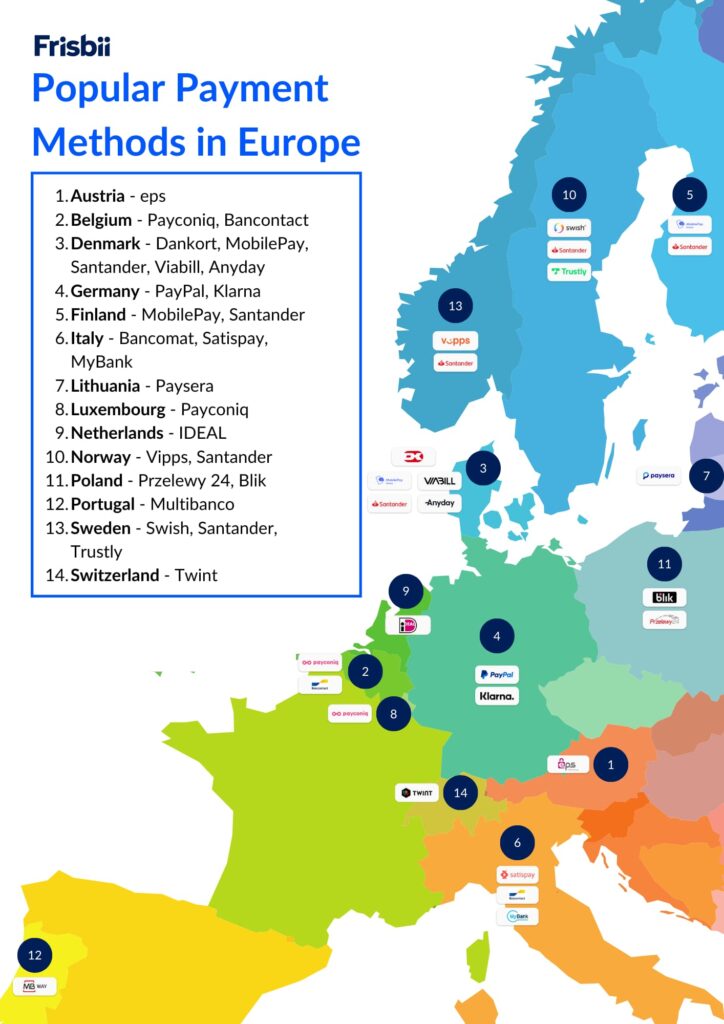
- Austria – eps
- Belgium – Payconiq, Bancontact
- Denmark – Dankort, MobilePay, Santander, Viabill, Anyday
- Germany – PayPal, Klarna
- Finland – MobilePay, Santander
- Italy – Bancomat, Satispay, MyBank
- Lithuania – Paysera
- Luxembourg – Payconiq
- Netherlands – IDEAL, Tikkie
- Norway – Vipps, Santander
- Poland – Przelewy 24, Blik
- Portugal – Multibanco
- Sweden – Swish, Santander, Trustly
- Switzerland – Twint
Local payments with Frisbii #
With the Frisbii payment gateway, you can accept a wide range of local and global payment methods both for one-time and recurring purchases.
One of the advantages of using Frisbii compared to most other payment gateways is the option to switch and choose between different acquirers. Acquirer agreements are needed to securely process and accept payments. However, the choice of acquirers also impacts the payment methods you can offer as well as payment fees. With Frisbii, you have more control over your payment mix and fees to increase revenue and act flexibly according to your marketing strategy.
With Frisbii, you have more control over your payment mix and fees to increase revenue and act flexibly according to your marketing strategy.
We’re fully compliant with European payment regulations and requirements such as PCI DSS 4.0, SOC2 secure data handling, 2-factor-authentication and 3-factor-authentication as well as GDPR.
