


Providing the right European payment methods in your online shop or for your digital services is key to increase conversion and reduce cart abandonment. But Europe is a diverse ecosystem, so choose wisely.
Credit Cards #
Visa and Mastercard are by far the most popular non-domestic credit cards used in European countries. Cards like American Express or Diners Club barely make a mark statistically and therefore will not have much of an impact.
However, the market share of Visa and Mastercard depends heavily on the specific countries.
Finland, Ireland, the Netherlands, Poland, Spain, Sweden, Turkey and the UK are all very high in market share whereas countries like Belgium, Denmark, France, Germany, Italy and Norway prefer their domestic and other payment solutions over the global players.
(Source: Statista, 2021)
Mobile/Digital Wallets #
Digital wallets are quite possibly the future of European payment methods but still struggle to set foot in specific countries, especially when it comes to online payments.
For example, in most European countries, Apple Pay is quite popular for in-store payments (usage ranges from 30 % to 67 %), whereas online, consumers are less likely to use the digital wallet (15 % to 40 %), probably because they have other payment methods in place.
(Source: Statista, 2024)
The type of digital wallet that is popular in each country also highly differs. Apple Pay and Google Pay might sound like no-brainers but in countries like Germany, PayPal reigns the digital wallet market, since it’s known there since the early years when it was still associated with the marketplace ebay. 91 % of German users pay with PayPal compared to 17 % who use Apple Pay or Google Pay.
On that account, PayPal leads the selection of payment methods in Europe if you want a more general option next to your local choices. If you want to cover many European countries, it is much more important than Google Pay or Apple Pay. Although in-store payments via PayPal are much lower (31 % to 49 %), the online payments market share ranges from 76 % to 91 %.
(Source: Statista, 2024)
Debit & bank transfers #
Online payments via debit cards, direct debit and bank transfers are still highly popular among consumers and customers alike and should therefore be part of your payment method mix.
More than 50 % of European consumers/customers buy items with small or big order sizes with debit cards (ca. 25 – 28 %), direct debit (14 % – 15 %) or bank transfer (11 % – 12 %).
(Source: Statista, 2022 for small and big order sizes)
Domestic payment methods in Europe #
Proper research is needed for you to identify your key countries for a European market strategy and focusing on their preferred payment methods. That way, it’s much easier to focus on the countries that are likely to have the biggest impact on your revenue and add the right payment methods for your new customers.
For some markets, aside from the general payment methods, there are domestic payment providers that are key to success since they are usually preferred by customers. For example, in Denmark, offering MobilePay can increase conversions significantly since it is one of the most popular local payment methods and in direct competition with global players such as Visa and Mastercard or Apple Pay.
“I love that Frisbii integrates with so many different payment solutions which is nice. Right now, we’re just using credit cards on Happy Helper, but I really want to enable MobilePay and a couple of other solutions.”
Saxo Merrild, CEO of Handyhand & Happy Helper
Popular domestic payment methods in Europe – selected countries #
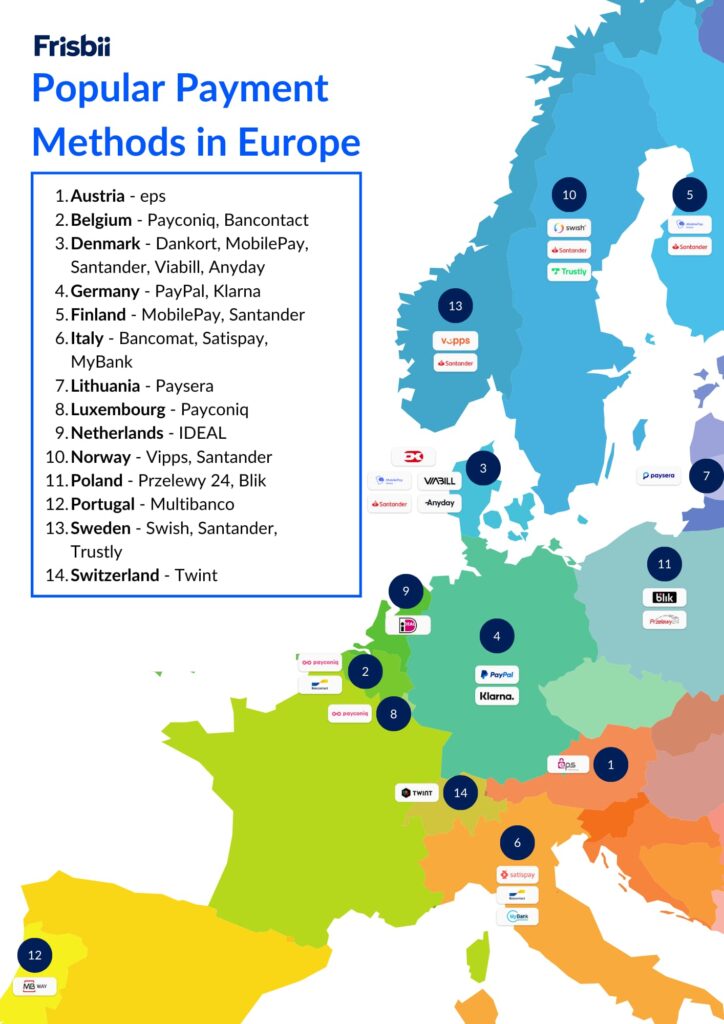
- Austria – eps
- Belgium – Payconiq, Bancontact
- Denmark – Dankort, MobilePay, Santander, Viabill, Anyday
- Germany – PayPal, Klarna
- Finland – MobilePay, Santander
- Italy – Bancomat, Satispay, MyBank
- Lithuania – Paysera
- Luxembourg – Payconiq
- Netherlands – IDEAL, Tikkie
- Norway – Vipps, Santander
- Poland – Przelewy 24, Blik
- Portugal – Multibanco
- Sweden – Swish, Santander, Trustly
- Switzerland – Twint
Local payments with Frisbii #
The Frisbii payment gateway offers more than 50 payment methods that are specifically curated for the European market (and beyond), so you can provide global and local methods for higher conversions and less cart abandonment.
One of the advantages of using Frisbii compared to most other payment gateways is the option to switch and choose between different acquirers. Acquirer agreements are needed to securely process and accept payments. However, the choice of acquirers also impacts the payment methods you can offer as well as payment fees. With Frisbii, you have more control over your payment mix and fees to increase revenue and act flexibly according to your marketing strategy.
We’re fully compliant with European payment regulations and requirements such as PCI DSS 4.0, SOC2 secure data handling, 2-factor-authentication and 3-factor-authentication as well as GDPR.
Download the Frisbii payment guide to optimize your checkout conversions #
Our European Payment Guide provides you with current payment trends and methods as well as an overview of different payment behaviors across Europe.
Find out why picking the right payment mix can impact your bottom line, reduce cart abandonment and increase customer trust.
Covered in the guide:
- Why the right payment method matters
- Payment trends for digital wallets, credit cards, debit and more
- Payment habits in the Nordics, DACH, Southern Europe and Benelux countries
Fill out the form to receive a PDF copy
