


Your billing and payments setup is the foundation of your SaaS finance processes and your revenue management. To make sure your business is set up to act flexible and adapt to market changes, you need to pick a solution that covers all your bases.
Billing automation #
The automation of your billing is a given, since it can reduce manual labor, manual errors and enable scalability. If you are able to automate the majority of invoicing and billing processes, you can safely grow without encountering bottlenecks or increasing errors.
Automation also creates more transparency over processes and can be extended to other workflows for sales, marketing, finance, etc.
“Frisbii has enabled us to reduce the time spent on invoicing. Our team can focus more on higher value-added tasks such as key account litigation.”

E-invoicing #
If you do SaaS business in Europe, especially in the B2B field, you will require e-invoicing to be and stay compliant on the European market. Although e-invoicing laws and regulations differ depending on the country, the overall goal is to enable them EU-wide as an invoicing standard.
Read more about the topic and how Frisbii supports e-invoicing in your country.
Revenue recognition #
Revenue recognition is a crucial aspect of subscription billing and ensures that the money is recognized properly for clean finances. To quote from our article about revenue recognition:
“According to the revenue recognition principle, companies generate revenue when they have delivered products or provided services to their customers. The recognition does not take place at the time of the payment transaction, but when the service is rendered.”
For example, if a customer pays for an annual subscription, the amount is not immediately recognized as a whole but rather split up over the next 12 months. Every single month, a 12th of the initial payment will be recognized in accounting since the service has been provided for that month.
Revenue recognition can get quite complex, if you add usage-based billing, downgrades, upgrades, cancellations and add-ons to the subscription mix. For example, how should you bill a customer who cancels their subscription in the middle of the month/billing period?
It is therefore important, that your SaaS billing platform provides this functionality.
Rolling reserve #
A rolling reserve is a percentage of your revenue that’s being “reserved” by your payment acquirer to cover refunds and protect against fraud. The timeframe in which a reserve is kept depends on the payment method and chargeback/refund regulations of the country you’re operating in.
Rolling reserves help reduce potential losses due to chargebacks, fraud or other risks. They can improve your cash flow management and make sure your revenue data and financial planning stays predictable. And it provides you with sufficient funds to cover for chargebacks and refunds, since the reserved amount is saved specifically for these cases.
Read more about rolling reserves and how they are managed.
Automatic payment reminders #
Payment failures are part of any business but there are ways to decrease the amount by a huge percentage if your SaaS billing has the right functionalities.
Payment reminders can work wonders with failed or late payments. They keep the customer relationship healthy, the reduce workload since your customer support doesn’t have to contact customers themselves and – above all – they can secure the majority of your payments if you are patient enough:
If you give customers at least three chances to pay their invoice, you can get up to 73% of your late invoices paid.
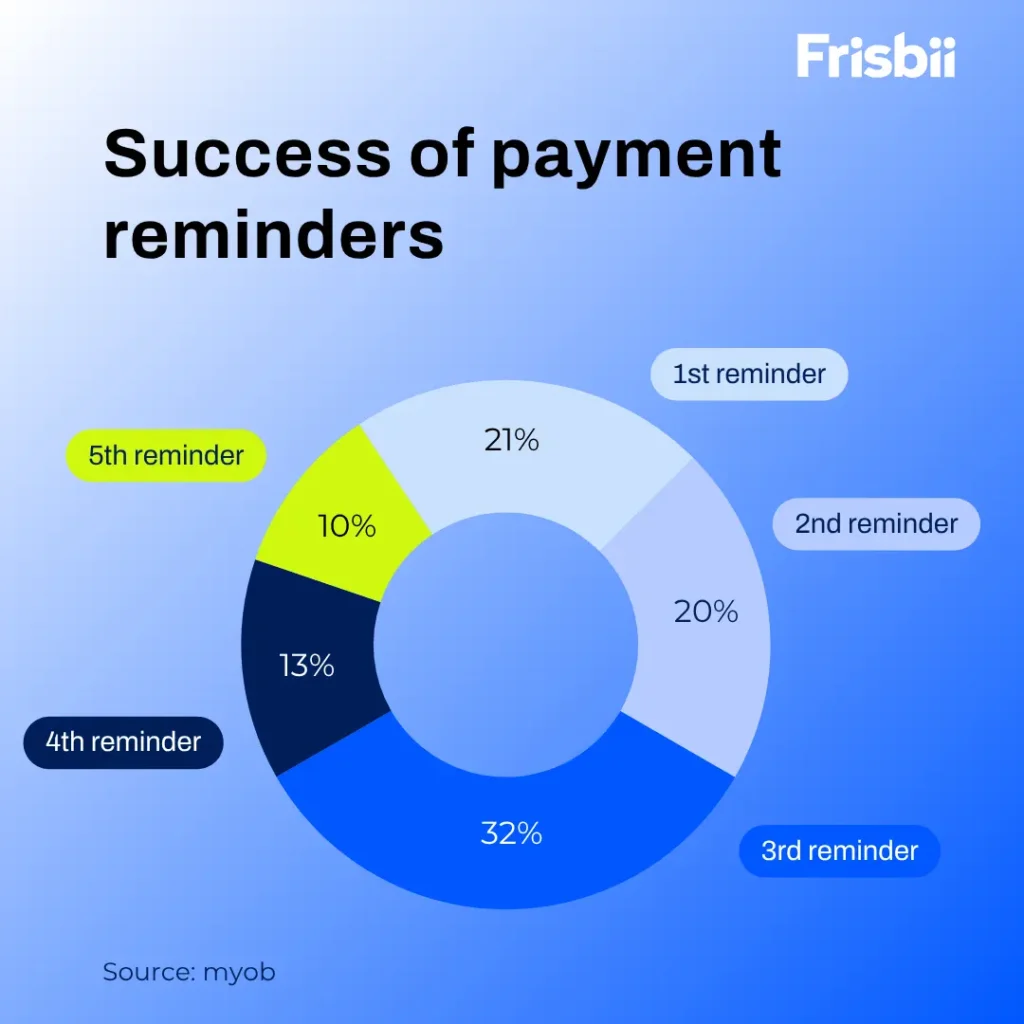
Success of payment reminders
- 1st reminder: 21% of late invoices paid
- 2nd reminder: 20% of late invoices paid
- 3rd reminder: 32% of late invoices paid
- 4th reminder: 13% of late invoices paid
- 5th reminder: 21% of late invoices paid
Souce: myob
Usage-based billing #
In our Billing software evaluation guide, we discuss the importance of a strong and flexible billing infrastructure to actively support your business strategy and enable you to act swiftly to market changes.
We found that many SaaS companies are currently struggling to properly monetize AI-based functionalities, since static subscription pricing models do not really fit the different levels of AI-usage of customers. And even outside of AI functionalities, you might have features and service plans that have fluctuating usage patterns.
A hybrid pricing model that combines a static base subscription coupled with usage-based pricing for AI-features, service levels or other offers can help you and your customers to gain more control over the overall pricing and usage. However, usage-based billing is more complex and not always included in generic subscription management tools.
API First and/or accounting plugins #
SaaS billing automation can only work properly if you are also able to integrate your billing processes seamlessly with your accounting to ensure data transparency and accuracy. Depending on your IT resources, you usually have different options:
Plugins – are low-code or no-code options to connect your SaaS billing with your accounting software without a lot of effort. These plugins are usually provided by either software vendor.
API – a SaaS billing solution with an API First approach supports dev teams to create and customize the integration with your billing tool and accounting software. Whether you have an in-house dev team or work with an agency, a clean documentation and proper setup can reduce the workload and decrease implementation time.
Compliance & security #
If you are operating in Europe, you want to make sure that your billing setup is fully compliant and adheres to local regulations:
- PCI DSS 4.0 – Payment card industry data security standard
- GDPR – General data protection regulation
- SOC 2 Type 2 – Cybersecurity compliance framework to ensure that third-party service providers store and process customer data in a secure manner
- 3D Secure – Protocol that acts as an additional security layer for online credit and debit card transactions
- 2FA – Two-factor authentication
- MFA – Multi-factor authentication
Recurring payments processing #
To accept and process payments, you will also need a payment gateway and acquirer agreements. The right payment mix is more than just picking the most popular options. Ideally, you will evaluate local payment options, ease of use, security, fraud protection and payment fees for smooth SaaS payments.
Most SaaS billing platforms need to be connected to an external payment gateway. Some exceptions, such as Frisbii and Stripe, provide both a billing and payment solution. However, make sure you stay in control over your acquirer agreements.
Why is acquirer agreement flexibility important?
Choosing the right payment methods
Each acquirer agreement will allow you to offer one or more payment methods. However, different acquirers offer different payment methods. Especially local marketing strategies sometimes require local payment methods which are not offered by many acquirers but can increase conversions drastically.
For example, we advise any business that wants to operate in Denmark to offer MobilePay. Likewise, a Swiss market strategy will lose a lot of customers if it can’t provide Twint.
Reducing costs with the right payment fees
Each payment method usually comes with a payment fee that is calculated differently depending on the method and the acquirer. These costs can add up if you pick the wrong payment method.
Our customer Sol og Strand was looking for a popular German payment method for high one-time transactions. Initially, they considered PayPal which is hugely popular in Germany. However, PayPal’s fee is based on a percentage of the transaction sum which would have cost the customer a lot based on the higher transaction sums of their business model. Instead, they opted for SEPA card payments that have a static fee per transaction.
The more control you have over your payment methods and acquirers, the more you can pick the right payment and payment fee mix to optimize your revenue.
Acquirers for high-risk companies
High-risk companies (such as gaming, pharmacies, online dating, etc.) can struggle to find the right payment provider since many acquirers will not accept high-risk businesses. There are, however, acquirers that are specialized for these industries (e.g. Shift4).
Acquirer rerouting
Being able to choose more than one acquirer can help you in case an acquirer network is down (which means, you will not be able to process any payments during that downtime). If you have more than one acquirer, a rerouting in the background can ensure that your customers won’t notice any difference.
Billing analytics #
Your billing data tells you a lot about the success of your business and it can help identify revenue leaks and potential churn triggers. Every SaaS billing solution should provide you with options to use and view revenue, payments, subscription and churn data.
Additionally, you might want to look out for a vendor that also offers predictive analytics to help you gain insights into churn behavior, identify high-quality customer segments and predict pricing change outcomes.
FAQ #
What is SaaS billing and payments?
SaaS billing covers the entire process of managing and accepting recurring payments, sending out invoices, managing revenue recognition, dealing with late or failed payments and providing accurate and clean data for your accounting to make sure that your subscription revenue is properly allocated and your cashflow is steady and reliable.
Goal of any SaaS billing setup is the successful automation of processes, data transparency and reduction of any friction (e.g. errors, delays, etc.).
What makes SaaS billing and payments different?
In contrast to one-time payments, SaaS businesses deal with recurring payments and – depending on your portfolio – complex subscription plans that include discounts, trial periods, add-ons, usage-based assets, and more.
From allocating revenue properly to creating and sending out compliant and transparent invoices on a regular basis, your billing setup needs to be reliable and scalable, so your business can grow without an increase in errors or delays.
In our SaaS market trends article, you can read about new technologies, business practices and market disruptions that impact SaaS businesses.
Frisbii is your SaaS billing solution to automate your billing, optimize your subscription management and provide a reliable checkout experience for a smooth customer journey.
Talk to our sales team to see where Frisbii can save you costs and increase efficiency.
