
Billing software evaluation
Your billing software evaluation guide
We compiled a comprehensive billing software evaluation guide that supports you with the process of finding a new billing software to strengthen your revenue infrastructure.
Included in our buyer’s guide:
- How your billing infrastructure impacts your revenue strategy
- The ROI of a recurring billing platform
- How much can you save with billing automation?
- The 11 core functionalities of a SaaS billing software
- 8 reasons why you have outgrown your manual billing
- 7 reasons why you have outgrown your current billing platform
- Your billing software evaluation guide
- 7 steps to migrate to a new billing software
- The secret to a successful migration to a new billing software
Fill out the form to receive your copy
Download your evaluation guide
Revenue strategy
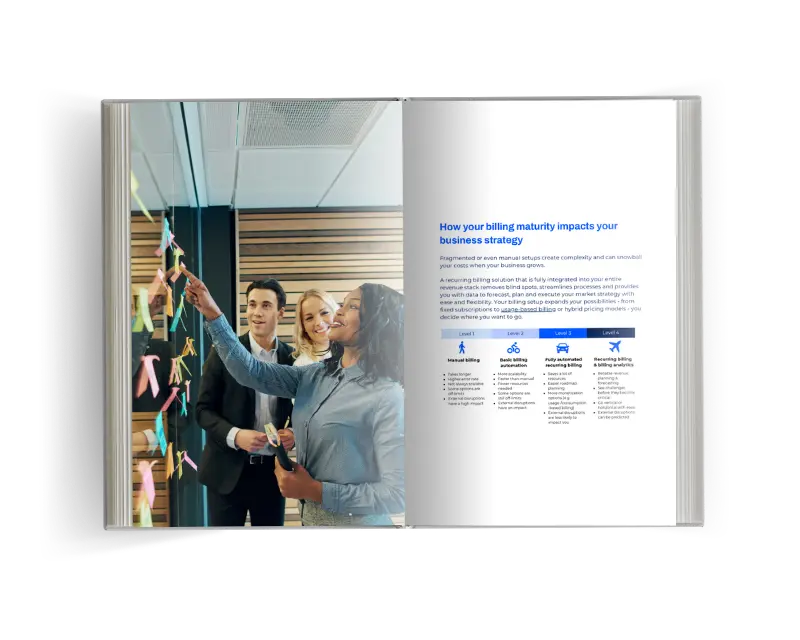
Your billing infrastructure impacts your strategy
(Recurring) billing is not just a finance topic. If you have a billing software that easily scales with your business growth, can be used for different pricing and billing strategies and is seamlessly integrated into your accounting tech stack, you gain more control over your revenue data and activities.
Read in the Frisbii Buyer’s Guide, why billing actively shapes your strategy and how important billing automation is to not just stay afloat but to race ahead in an ever-changing market.
Identify pain points
Where do you lose money due to bottlenecks, data silos, manual workflows or complicated workarounds?
Calculate the cost of your manual invoice processing and read in our software evaluation guide how to define real use cases based on your current billing and subscription management setup.
Define priorities
Go through our comprehensive list of standard subscription billing features and decide which are necessary for your current and future business setup to make sure you have a comprehensive list to evaluate potential vendors.
Learn, why some features are closely linked to the overall costs of your subscription billing solution.
Evaluate vendors
Make use of our vendor evaluation template to weigh must-have and nice-to-have functionalities, add your own and see at one glance which vendor is best equipped to support your subscription billing with an intuitive platform across different business units and project phases.
Billing automation
How much can billing automation save you?
Even in big finance teams, many invoices are still handled manually because there are no appropriate systems in place to manage more complex billing models. However, manual billing is not just difficult to scale but also increases the amount of billing errors which can cause criticial compliance issues and negatively impact customer relationships.
Use our billing savings calculator to see how much money you can save each year when you switch from manual to automated billing.
50%
is the average of work saved with billing automation for our customers
Software evaluation
Evaluate billing software vendors with our evaluation matrix
Our Buyer’s Guide includes a billing software evaluation matrix to weigh different features and capabilities and compare vendors at a glance. Additionally, we provide you with a list of the most common capabilities a strong billing software should provide – depending on your business model and market strategy.
Dive into the must-haves and the nice-to-haves and make the right choice based on your individual use cases and pain points.
Find the best recurring billing software
Read, how to define use cases, create a long list and turn it into a short list and avoid migration pain points with our comprehensive billing software buyer's guide.