


Is SaaS in a crisis? Industry experts François Suret and Olivier Fourment sat together and discussed the changes that software companies are currently facing – and how to avoid revenue leaks during volatile times.
Why has SaaS growth slowed down? #
- A volatile market
- Disruptive AI solutions
- Higher churn due to
- easier cancellation options
- more competition
- more cost awareness
SaaS growth has slowed down due to the economic and geopolitical climate. Instead of just chasing growth at all costs, investors are now also looking at profitability.
Additionally, the disruption of generative AI has created a true competitor for easy, straightforward SaaS solutions and has already caused some pretty big movements on the stock market with many investors selling their SaaS stocks to invest them in semiconductors.
In January of 2026, the S&P 500 Software Index dropped 8,7% in a single day. By March, the overall loss in stock market value was at 1 trillion US-Dollars (source: Tunga).
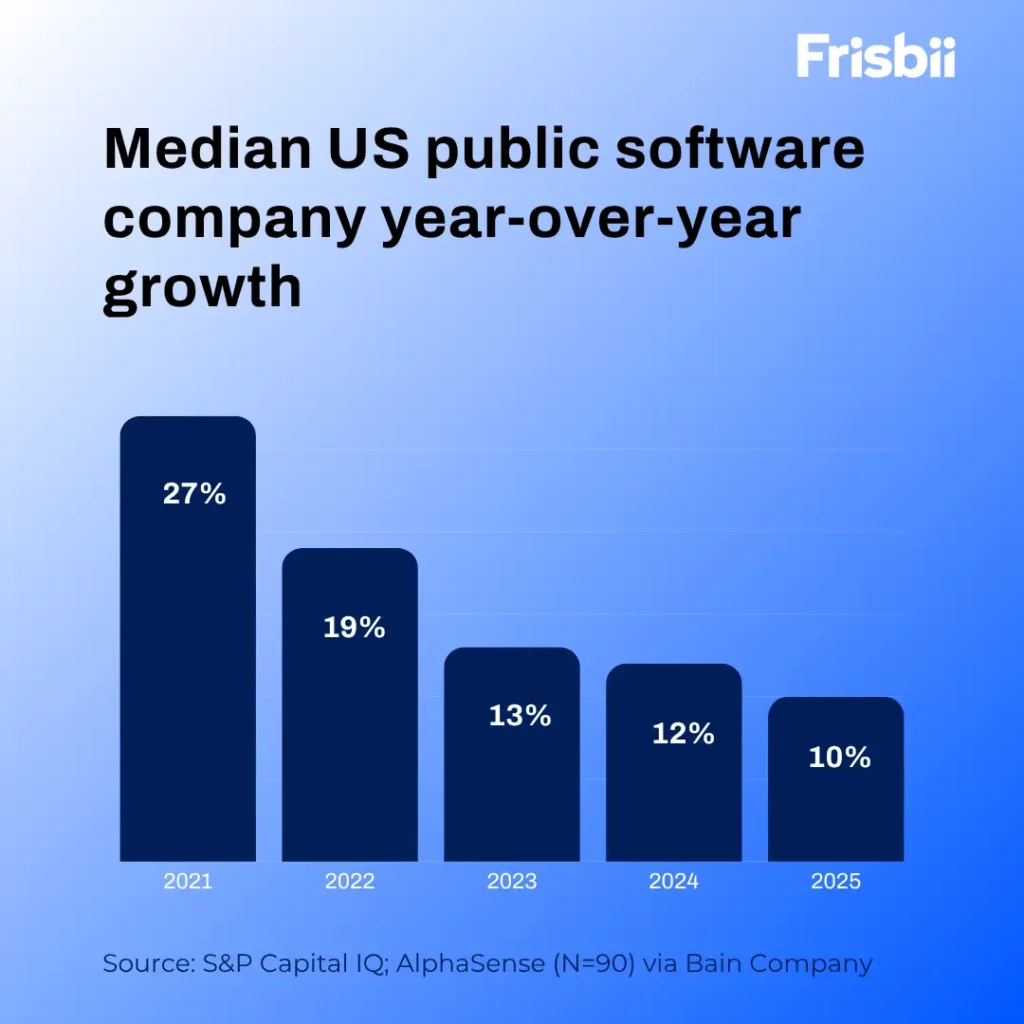
Reports from S&P Capital IQ show that the median growth for US public software companies has declined drastically in the last 5 years.
That’s good for any company that produces hardware, but it puts SaaS companies in a tight place.
Churn is rising and conversions, especially for long-term customers, are going down (this phenomenon is also often described as “subscription fatigue“. Many subscriptions are being cancelled earlier due to customer-friendly regulations that prevent fraudulent practices to keep subscribers locked in. At the same time, the competition has increased due to accelerated development cycles at lower costs. Customers have more choices than ever for nearly every single technical functionality imaginable.
Additionally, customers are much more aware of their expenses and have a better overview of their subscriptions because banks and other FinTech companies have found a healthy market in apps and dashboards that provide customers with more insights and direct control over their spending.
Why your customers are trimming the fat #
The average SME has 162 applications according to Zylo. However, enterprises can have two, three or even four times of that amount depending on their size. That number weighs down expenses. There is even a term for it: “Bill shock”, when you see how high your costs actually are when you receive the bill at the end of the month. With many SaaS including usage-based AI-features that are less predictable than a fixed subscription price, the bill shock these days can be quite jarring.
Businesses just like B2C customers end up trimming the fat, asking themselves, which solutions and apps they can live without because:
- they are too expensive
- there are free or cheaper options on the market
- they are not using them as often
- they don’t provide enough value for the cost
- their pricing models are not flexible enough
- the subscription can’t be paused, only cancelled
- the service is frustrating and takes too long to solve issues
- there is too much lag or downtime
For SaaS companies – and really any subscription-based business, if we’re being honest – this has become a huge issue when it comes to annual recurring revenue (ARR). Revenue forecasting seems less reliable, expected growth has declined or stalled, and the market is volatile which makes it difficult to anticipate new trends and changes.
The solution: More control over your revenue with automation and data consolidation #
Full transparency into your own revenue data, your billing processes and your costs can give you a huge advantage during critical times because it allows you to identify revenue leaks that are causing frictions for your customers, increase costs (needlessly) and hinder cashflow.
You will gain a lot more control over your SaaS growth when you have visibility over the entire revenue flow and know how it changes (seasonal, campaign-based, caused by market changes). And you can ensure that you’re not throwing money out of the window due to late payments, buggy processes or friction along the customer journey.
Where is your revenue coming from?
Most SaaS businesses do have more than one subscription plan (e.g. starter, growth, enterprise). However, they very likely also use discounts, free trials or freemiums and other pricing options to reach more audiences.
You need data insights that tell you where the majority of your revenue comes from and what the customer lifetime value for your different plans are. This data can help you see beyond conversion rates and find out which plans and campaigns actually generate high customer lifetime value (LTV), low acquisition costs or at least a good ratio of both.
Based on this data, you can remove or change plans, free trials or campaigns that have a high acquisition rate but equally high churn or low LTV.

Where are your revenue leaks?
Revenue leaks occur whenever a process, a cost, or an activity is cutting into your overall bottom line. It is quite difficult to identify revenue leaks because they can hide in plain sight or be hidden deep within your systems.
However, having a good overview of your systems and processes makes it a lot easier to detect them. A big issue of manual processes or software solutions that are not connected to your tech stack is the lack of transparency they cause. This can even create compliance and security risks.
If you have transparent payments and billing data, for example, it is much easier to measure how long it takes until invoices are being processed and paid, how many late payments you have, how many of those can be recovered, etc.
How can you forecast revenue changes?
Forecasting is the golden ticket to SaaS growth and the best tool in any revenue leader’s kit. If you are able to predict your revenue, simulate how pricing changes affect your LTV and churn, or are able to identify campaigns that drive better results, you can reduce costs and increase revenue.
With the right amount of owned data and some help from predictive analytics, you increase the accuracy of your forecasting and can simulate outcomes to make the best decision.
Where do manual or outdated processes create bottlenecks and data silos?
There are many reasons why you still have manual processes in your business. Sometimes, it’s needed to ensure quality, sometimes there are no technical solutions that can do it (better). However, at the same time, many businesses rely on manual processes because they used to work at some point. But as our own experiences with software migration projects have shown, many companies have kept these old processes for so long that they don’t even realize the many bottlenecks, errors, compliance risks and revenue leaks that are embedded in them.
Documenting which of your processes are manual or outdated can help you to evaluate which ones can be automated or optimized to streamline processes, create more transparency (and control) or even re-think and adapt workflows and standards for better outcomes.
What can you do to grow your revenue?
We’ve heard from our customers time and again, that using a professional subscription management software early on, instead of relying on freemiums or inhouse workarounds can solve a lot of problems and provide reliability once your business grows to a size where manual workflows and free subscription and billing solutions are no longer sufficient.
A reliable finance infrastructure enables flexibility regarding your pricing models and product portfolio. It ensures compliancy and keeps manual labor down while easily scaling during growth spurts without increasing error rates.
Additionally, a professional software has functionalities and data insights that actively support retention and prevent and/or reduce churn (e.g. payment reminders and automatic credit card updates to avoid involuntary churn, options for loyalty rewards, churn triggers, etc.).
Frisbii helps you gain data transparency, manage your subscription plans, pricing, invoice management and billing as well as all recurring payments in one single platform. From simple subscriptions to usage-based billing – everything scales with your business growth.
Even better – we offer e-invoicing support that will help you sell across European markets fully compliant and without any additional work on your end. And our Revenue Insights forecasting labs provide you with pricing simulations, churn prediction (and prevention) as well as acquisition optimization.
See for yourself and book a demo to discuss your SaaS growth strategy with our team.
