


An important part of subscription management is to ensure a low customer acquisition cost and a high customer lifetime value. But it’s a tightrope balancing act, since a high CAC can also increase CLV. In this blog article, we’ll talk about the levers to keep the scales even.
What is an ideal LTV : CAC Ratio? #
It’s a simple and logical calculation: the budget you need to invest to gain a customer has to be exceeded by the revenue the customer makes. So how much CLV or LTV (short for customer lifetime value) does a customer have to generate, so their CAC (customer acquisition cost) is not only covered but also surpassed for a successful business?
A typical answer to the ideal LTV to CAC ratio is 1:3, so the costs you invest in the customer acquisition needs to result in 3 times the revenue to stay even.
However, this should be the bare minimum goal, since many CAC calculations tend to forget hidden costs (e.g., marketing and sales resources, time invest, etc.). 1:4 or even 1:5 should be the goal you set yourself, even though the latter is considered a bit of a lottery win.
What is CAC? #
CAC is also known as customer acquisition costs and describes the amount of money it costs to acquire a new customer. This can include different costs such as campaign budget, sales and support resources, revenue loss via discounts or freemiums, etc.
CAC are usually measured to get an average cost per customers per acquisition which can then be compared to the overall customer lifetime value (e.g. the revenue and other value of a customer until they churn). It is an important metric to evaluate whether acquisition strategies work, to identify the best performing strategies (e.g. the ones with the best CAC to LTV ratio) and to notice trends that require countermeasures.
How to calculate CAC
The easiest way to calculate the customer acquisition cost is:
All marketing and sales costs divided by the number of customers acquired = customer acquisition cost.
What is LTV #
LTV or CLV is also known as customer lifetime value (or simply lifetime value) and describes the overall money your company makes with a single customer until they churn / stop their relationship with your business.
The customer lifetime value is an important metric to track how much revenue each customer generates. It can also tell you how different customer personas or acquisitions from different campaigns or regions compare when it comes to their lifetime value, helping you to identify the most valuable customer segments and acquisition strategies.
How to calculate LTV
To be quite honest, there is not one true formula to calculate customer lifetime value since it depends on your data, your revenue models and other variables.
Probably the most simple approach would be to multiply the average yearly or monthly revenue* per customer with the average customer lifetime (e.g. six months, three years, 16 months, etc.).
*Whether you count the monthly or annual revenue depends on your average lifetime. If most of your customers churn after a few months, it makes sense to use the monthly revenue whereas business models with much longer customer lifetimes (often in the B2B and SaaS sector) could work with the annual customer revenue.

SaaS LTV increases over time #
An incredibly interesting survey by BCG (via Statista) showed that for SaaS companies, the true value lies in long customer relationships. As you can see, lifetime value of B2B on-premise software customers was the highest in its first year. In fact, the following 4 years combined earned as much revenue as the first year. However, the lifetime value for SaaS grows with each year, meaning that short-lived customer relationships keep overall profits down.
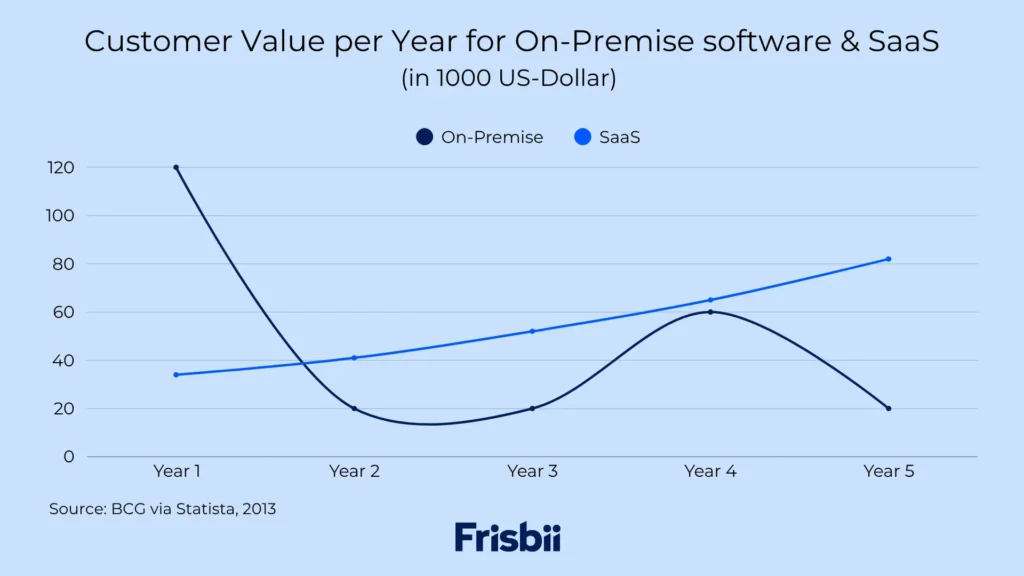
In short: LTV for SaaS is mostly defined by longevity.
The explanation is fairly simple:
- For on-premise software, it usually takes a lot of consultation workshops, trainings and other initial costs that the customer has to pay. It’s basically part of the on-premise software package to invest a lot at first, so you can be more independent later on.
- Once the system is in place, maintenance and other things are usually done by internal IT teams, so the revenue for the vendor is much lower.
- By the way, the increase during year 4 might be due to bigger “updates”, which for on-premise software still is a bit more complex than updates for cloud-applications which usually run in the background without much disruption.
However, for SaaS customers, the first year customer value is on average relatively low and will rise each year
(the data did not go further than five years)
For SaaS customers (and many other digital subscription customers), the initial acquisition vs. value ratio usually is less favorable in the first year due to typical subscription standards:
- Freemiums, free trials, discounts and other incentives decrease early revenue flows
- Sales and service teams usually offer their onboarding support for free, to reduce early churn rates.
- Once customers are properly onboarded and setup, however, there’s relatively few expenses but there’s more opportunities for up-sells or cross-sells (e.g., premium plans, more user accounts, etc.).
This means, that the LTV is highly dependent on a long customer life which also affects acquisition measures and customer expectations. Overselling a product or providing incentives for the wrong audience might decrease the customer acquisition cost and purchase decision cycle but can also negatively effect the customer lifetime value and thus hurt the bottom line.
Read in the interview with Saxo Merrild, CEO at Happy Helper and Handyhand, why LTV needs to be monitored because it will change (especially if you acquire a business with a loyal customer base).
What we found out from Happy Helper, for example, was that they had a pretty good revenue base and customers with a very high lifetime value. And we thought it would be pretty easy to just decrease CAC (Customer Acquisition Cost) and keep this CLV. We just needed to figure out the acquisition and then turn it up a notch.
But the lifetime value of new customers was not the same. Those existing customers had been nurtured over many years and new customers were not as loyal. For us, it was going back to the drawing board and identify how we can create an experience for the new users that is good enough to match the CLV of our legacy customers.
How to keep the customer acquisition cost low #
- Target buyer personas & audiences based on your most profitable customers (a target that’s too broad can increase CAC and lower conversions while increasing early churn rates).
- Make use of incentives but be aware that some incentives might increase a high early churn (e.g., after a discount or free trial period is over – read here, when to use free subscription trials and when to skip them).
- Be generous with making all information easily accessible that might play a part in the purchase decision (e.g., subscription pricing, product details, compliance, software requirements, etc.).
- Enable referrals through partners, customers (e.g. with rewards), and influencer campaigns. People trust people.
- Work with relevant inbound marketing content that talks about your target audience’s problems, offers solutions and provides tipps how to use your products and services for an optimized experience.
How to keep the customer lifetime value high #
- Reduce customer churn by addressing voluntary and involuntary churn (such as failed payments, expired credit cards, etc.).
- Reduce chargebacks and implement processes for disputes that remove friction and de-escalate if possible
- Make use of predictive analytics to identify customers in risk of churn and act before they unsubscribe.
- Nurture and reward your existing customers (e.g. with loyalty programs, relevant discounts, anniversary celebrations, etc.) and analyze reasons why they are subscribing (and stay subscribed)
- Enable seamless service experiences across all channels and throughout the entire subscription journey (self-service, customer portal, in-person, social media, etc.).
- Constantly monitor, identify and remove friction in the customer journey via reviews, support issues, complaints and other customer data.
LTV & expansion revenue: the dream team
Expansion revenue is the term for any additional revenue that can be made with existing customers by up-selling or cross-selling. Expansion revenue is the golden key to long-term success, since it gains new revenue streams from existing subscription customers.
According to studies (such as KeyBanc’s report from 2021, PDF), the CAC-ratio for newly generated ARR (annual reccuring revenue) between new customers vs. existing customers differs widely:
(Sales and marketing budget needed to gain 1 US-Dollar of new ARR from a new customer)
New customer CAC ratio: 1,67 US-Dollars ARR
Existing customer CAC ratio: 0,63 US-Dollars ARR
So, existing customer acquisition cost is not only 265% lower than the new customer acquisition cost but the ARR is also much higher than the costs, which means it creates profit right out of the gate, whereas new customers usually need to generate revenue for a while to “pay back” the CAC.
The AARRR framework is a standard framework to help optimize your entire subscription journey for more retention and revenue, thereby increasing your LTV. Read, how you can increase engagement, loyalty and the customer lifetime value with different measures and activities across the entire subscription lifecycle.
