

The SaaS market is in constant flux and probably one of the industries that are impacted most by technological trends, inflation and changing user behavior. So, what do the numbers tell us and which SaaS trends are shaping your business models? Let’s find out.
The big SaaS market numbers #
There will be growth but no growth explosion
According to Gartner, business software spend will grow 14,7% in 2026 which means an increase of 3,2% compared to last year (Source: Gartner, February 2026).
The SaaS market is the biggest public cloud sector
The SaaS market is the biggest sub-sector of the public cloud services market worldwide making up nearly two thirds with 412,5 billion US-Dollar revenue in 2023 compared to 123,3 billion US-Dollar for Platform-as-a-Service and 133,4 billion US-Dollar for Infrastructure-as-a-Service (Source: IDG via Statista).
US is the king of SaaS companies
The US are still the number one country when it comes to listed SaaS companies but given its size that is not really a surprise. It is interesting to note that compared to last year, the margin between the first and second place (still the UK) has decreased.
In 2025, the US still had 922% more SaaS companies than the UK. In 2026, it is “only” 748%. This might seem minor but looking at the huge increase of companies in pretty much all countries, there seems to be a big market shift. Compared to last year, almost all countries have doubled and even tripled the amount of their SaaS companies according to the SaaS database GetLatka.
Personally, I would wager that GenAI might have something to do with it, making it a lot easier to develop software with a smaller team and the help of an AI agent. However, it will be very interesting to follow these numbers over the next years to see if these numbers stay up.
| Country | January 2025 | April 2026 |
| US | 16.600 | 36,700 |
| UK | 1.800 | 4,900 |
| India | 1.200 | 3,900 |
| Germany | 925 | 3.000 |
| Canada | 1.200 | 2.300 |
| France | 816 | 2.100 |
| Spain | 367 | 1.200 |
| Netherlands | 328 | 978 |
| Sweden | 207 | 771 |
| Poland | 205 | 433 |
| Denmark | 147 | 517 |
Disclaimer: GetLatka is a SaaS database, so it’s very possible that the actual numbers differ.
Europe has a huge chance to stand out #
For years, the US pretty much governed the SaaS market and was often seen as the template for any SaaS company.
However, with the current political landscape, logistical and compliance challenges, European companies not only can but need to create an independent European software landscape to stay competitive and build their own customer base without constantly having to compete with US companies.
Advantages of European SaaS
- Fully compliant and up-to-date with any regulations and security standards
- More tailored to specific European and country needs which will make it easier for customers to get what they need instead of getting a software that was essentially made for a different market
- Local support, contracts, and offices for a closer customer relationship
- A big pool of incredible talent

The big SaaS trends & buzzwords #
GenAI disrupts the SaaS market
While most AI users are still contemplating how much they can trust their chatbot outputs, SaaS businesses are much more concerned about the disruptive effects that the AI boom had in the last few years:
- The use of GenAI has opened up new opportunities for services and features to expand SaaS portfolios, however, many companies struggle to align their AI features with the customers’ actual needs (e.g. AI bloatware)
- A lot of GenAI functionalities and agents threaten to eliminate the need for specialized software tools and services (this is also called “SaaSpocalypse”) to a point where even the big players such as Microsoft, Adobe, Salesforce and SAP have lost market value in 2026
- The uncertainty of successful revenue models regarding GenAI has created a minefield for pricing topics (e.g. fixed prices for GenAI functionalities can easily erode your bottom line)
Some say, that the SaaS industry had it coming because it opted for sales-led instead of product-led strategies, ignoring the development and optimization of their own products. But as with all true disruptions, the question is less about the cause and more about the solution.
- Agility when it comes to portfolio and strategy can help your company to change directions, adapt to the AI hype and concentrate on the unique value of your products and services.
- Staying cool-headed and seeing through the hype will be crucial to restructure. Not every doomsday scenario will come true. Acting out of fear immediately might harm your business a lot more than taking the time to come up with a reliable plan to transform your business.
- Pricing flexibility will help you to balance the cost of your GenAI-features. Our own experts are convinced that outcome-based usage-based-pricing works a lot better for any GenAI features than a fixed subscription price.
CLV (Customer Lifetime Value) & CAC (Customer Acquisition Cost)
In stark contrast to many eCommerce businesses, Software-as-a-Service lives from long-term customers with up- and cross-sell potential.
In the SaaS market, the customer acquisition cost is usually much higher in that it requires more services (marketing, sales cycles, onboarding, implementation) with less revenue (due to freemiums, free trials and discounts).
Changing customer expectations and habits can also impact the expected LTV. Some of our tech customers have experienced that existing customer bases tend to have a much higher LTV than newer customer bases. Times are changing, and so are customers.
Keeping CAC (comparatively) low while simultaneously generating loyal customers with a high LTV will be the big differentiator for SaaS companies in 2025.
Hyper-Personalization
In my humble opinion, “hyper personalization” is the new “omni-channel-communication” of customer journeys. Everyone will talk about it. Everyone wants to have it. But in reality, it’s costly, it needs focused use cases and it’s actually not necessary for every industry to create satisfying customer experiences.
Most practical examples for hyper-personalization come from streaming or social media, where it’s easy and logical to use real-time data to recommend content and products. From the Spotify-wrapup to Netflix recommendations – hyper-personalization is accepted, entertaining and shallow enough to be seen as an advantage.
But in many other industries, it’s important to ask yourself if you really need hyper-personalization to sell your product or service. A software that covers a necessary repetitive task does not need real-time data to make cross- or upsell suggestions or provide the right content. Historical data might be just fine to give customers the right guide, help advice or app suggestion.
And in some industries and circumstances, hyper-personalization might even be creepy. Customers can be turned off a brand if it “knows too much” or becomes too invasive. Sure, receiving a discount code just as you pass your favourite coffee shop is great. But it’s also a stark reminder that this company knows where you are at all times.
What companies think hyper-personalization is:
Knowing every little detail about their customer’s movements, desires and profiles to engage with them and increase spending and loyalty.
What customers expect from hyper-personalization:
- Not to be creepy and/or invasive
- Enable Auto-fill forms and other ways to reduce repetitive data input
- Being recognized by service personnel
- Having more functionalities for proper self-service (payment, invoice, and subscription management vs. endless help forums)
- Relevant marketing material and discounts based on purchase and usage behavior (aka: no spam)
The big SaaS must-haves of 2025 #
Integration for all kinds of end-users
Integration is key for nearly every single SaaS out there. Whether you have a B2B platform that needs to be integrated into your customers’ ecosystem, or you offer B2C services that enable social media connections – the IT ecosystem is real.
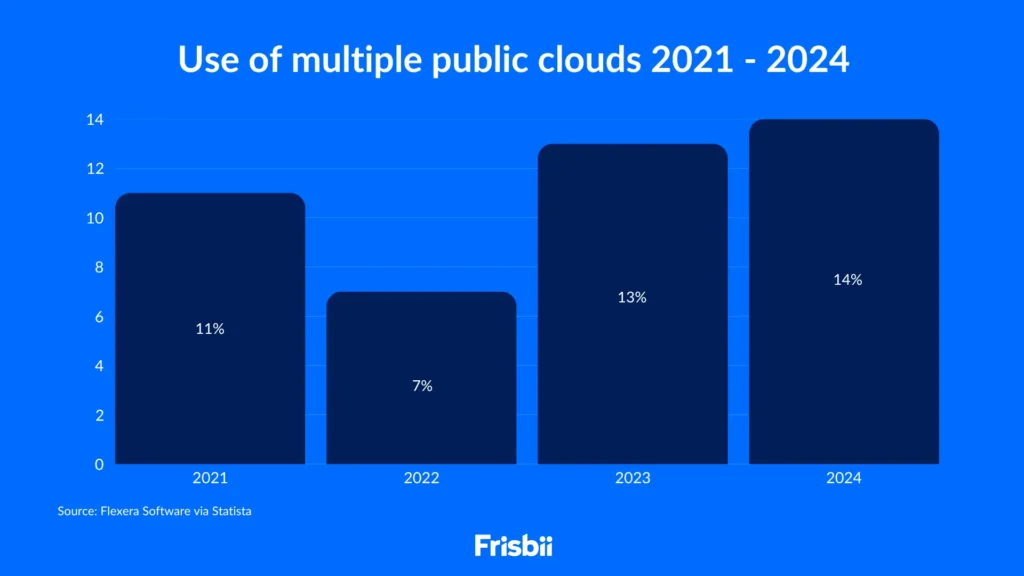
In fact, enterprises are relying more and more on multiple public cloud services than on hybrid clouds (source: Flexera Software via Statista).
Use of multiple public clouds 2021 – 2024
- 2021: 11%
- 2022: 7%
- 2023: 13%
- 2024: 14%
It’s very likely that sometimes, an SaaS solution in the public cloud fits the business case a little bit more than a hybrid cloud compromise. But it’s all the more important that the different SaaS can still be fully integrated into the IT ecosystem for seamless data management, compliance, collaboration and control.
Speaking from our own experience, we found that an easy decision-maker for software users it to address different user types – from developers to power users to experts who don’t have time for complicated setups. You never know who will be tasked with the setup of the software, especially when it addresses small- and medium-sized companies that not necessarily have a big IT force.
That’s why we at Frisbii offer Open API, webhooks and eCommerce plugins, to provide options for developers and business users alike.
Compliance as a default and as a feature
Depending on your industry and markets, your compliancy and security standards can be pretty high. But for many companies, it’s not just important that the standards are met but that you offer functionalities that help with related compliance and security issues to not just provide security by default but even further lessen the workload of your customers.
For example, our payment gateway has a risk filter that allows companies to set their own “alarm flags” for customer behavior and activities to reduce fraud attempts and other security issues.
Likewise, we enable a DATEV export of invoice data for our German customers, since this makes finance management for our customers so much easier.
Putting the Service in Software-as-a-Service
The SaaS market is a booming business. Especially with AI and automation, it can seem as if an idea and some sales talent is enough to build a proper business model. But here’s something you probably don’t need to hear from me: SaaS is also a people business.
Too many software companies have forgotten that especially highly competitive Software-as-a-Service models are all about the service. And no, reyling on an AI chatbot and a self-service help center is good but not enough.
Proper onboarding, digital (and if needed: in person) training, a good and responsive service team, contact options, guides and walkthrough videos are all part of what will create trusting relationships with your customers and furthermore increase your conversion rate.
After all, new customers who have no idea what to do with your tool will very soon be former customers.
Priority equals efficiency: keep your eye on the prize
In our new interview series, we talk to our customers about their business models, pain points and best practices. Of the two tech platforms we covered (Waitly and Happy Helper), both CEOs told us that it’s important to stay focused and lean. Director of Product – Payments & Partners Markus Brunke explains in his interview with us that a good roadmap looks out for solutions that many customers can profit from.
You need to prioritize across different business units:
- What core functionalities make the most money?
- What new functionalities will have the biggest revenue and market impact?
- What new and core functionalities are most expensive / cheapest to maintain?
- What customers need prioritized support?
- What markets need a higher focus?
- Etc.
It’s easy to get distracted by new trends, cool ideas and customer input. But the bottom line is most important. Streamlining and prioritizing can also take pressure off your employees. Organizing their tasks and deadlines is much easier if everyone knows what has the biggest impact.
The big SaaS questions of 2025 #
AI or not AI? – That should not be the question
If you have a SaaS business, I am quite sure you use AI in one capacity or the other. But when it comes to your investment decisions, you should not ask yourself if you need any or more AI. You should rather ask what pain points you have, what processes can be optimized, what software features can be added – and then look for solutions that might or might not include AI.
It’s like doing arts and crafts and deciding to use a chainsaw before you’ve even decided whether you want to build a tree house or knit a sweater (hint: for one of these two, the chainsaw is NOT appropriate).
Is Usage-based pricing the right model for your business?
As already mentioned, the huge shift towards AI-based features and functionalities has introduced the need for more flexible pricing models to account for the slightly volatile costs a GenAI function can have. Most SaaS companies that offer GenAI functions do pay one of the big players (Anthropic, OpenAI, Microsoft) to process each prompt and output.
However, since AI-output is notoriously hard to predict, you do not know whether a customer will get their desired result after 3 or 30 prompts. If you have to pay a fee for each prompt, those 30-prompt-customers will soon destroy your bottom line.
Usage-based billing (or pricing) is the perfect way to keep prices fair and transparent. Especially when the price is outcome-based (a customer will pay for a valuable result) and coupled with a classic subscription plan for your core product, you are much more likely to keep your revenue forecast predictable and stable.
Product-led or sales-led growth?
Product-led growth (PLG)
Is mostly about strong marketing, free trials and easy self-service onboarding. The product speaks for itself, and the product journey should mostly be possible independently from your sales or support staff.
This usually also means: a higher quantity of customers with a relatively short sales cycle.
Product-led is often used for software for private customers, freelancers and small- or medium-sized businesses. The product should be easy to use out-of-the-box with few implementation requirements.
An example would be a design platform like Canva: users can start working with Canva almost immediately since the setup does not require any technical or security know-how.
Sales-led growth (SLG)
Involves a longer sales cycle, the building of trusting relationships, personal demos, implementation or consultation, and overall, a closer human connection. That’s usually necessary because sales-led growth is mainly for higher-priced subscriptions in the B2B sector that require more trust and proof before a long-term decision is being made.
An example would be a CRM system like Salesforce, which has a long implementation cycle, a high degree of customization (form fields, data integrations, etc.) and also requires detailed security and compliance audits as well as longer onboarding and training sessions.
According to Goodfit (via notion.vc), sales-led strategies are more popular with a market breakdown of 71% vs. 29% for product-led. The article further states that purely product-led companies can get some advantages in early investment stages but that sales-led is not just the more popular model but also increases in impact in later stages.
There is a third option:
There have been suggestions to follow a combination of PLG and SLG, stating that it can leverage the best of both worlds.
Since both models have advantages and disadvantages, here’s a wild thought: why not try both? Of course, this depends on your SaaS product. If you offer a simple software solution without higher-priced tiers or enterprise versions with individual service level agreements, the logical way to go is product-led.
And if you only have a big hunk of an incredibly versatile enterprise software that needs implementation cycles, customizations and requires a long sales cycle to settle all open questions, then sales-led is your golden ticket.
But if you – like many SaaS vendors, offer a software that can be fully or partially used by B2C customers, small companies, freelancers but also medium-sized companies and enterprises, then a combination of the two could help you test out different approaches and widen your lead generation.
However, a decision like this should be prefaced with a realistic look at the numbers. A dual approach could create a higher CAC payback and overspending for the product-led side of business which is something you’d want to keep an eye on and test out before fully committing to a dual model.
If you want to stay up-to-date with subscription trends, follow us on LinkedIn or take a look at our subscription podcast list to listen to during your morning commute.
Frisbii provides you with subscription management and payment solutions to support your SaaS business and stay agile when it comes to SaaS trends. Set up your plans, experiment and optimize your pricing structures, offer a self-service customer portal and gain insights into your revenue data, customer activities and more – easily setup and integrated.
